Child Sexual Abuse
CSA Professionals Page – Priority 1 Child Sexual Abuse
Welcome to Cheshire West and Chester Safeguarding Children Partnership Priority page for Child Sexual Abuse - information for Practitioners.
Child sexual abuse involves forcing or enticing a child or young person to take part in sexual activities, not necessarily involving a high level of violence, whether or not the child is aware of what is happening. The activities may involve physical contact, including assault by penetration (for example, rape or oral sex) or non-penetrative acts, such as masturbation, kissing, rubbing, and touching outside of clothing. They may also include non-contact activities, such as involving children in looking at, or in the production of, sexual images, watching sexual activities, encouraging children to behave in sexually inappropriate ways, or grooming a child in preparation for abuse. Sexual abuse can take place online, and technology can be used to facilitate offline abuse. Sexual abuse is not solely perpetrated by adult males. Women can also commit acts of sexual abuse, as can other children (as defined in Working Together to Safeguard Children 2026).
Cheshire West and Chester Safeguarding Children Partnership recognise that the impact of sexual abuse can last a lifetime and can have both short term and long-term effects. Our priority aim is to work collaboratively and collectively so that anyone who comes into contact with children and young people is able to recognise, understand and know how to respond to cases where a child or young person may be at risk of, or experiencing, child sexual abuse
You can also read our practice resource briefing by clicking on the link below.
Sexual Abuse - Practice Resource Briefing (Feb '26)
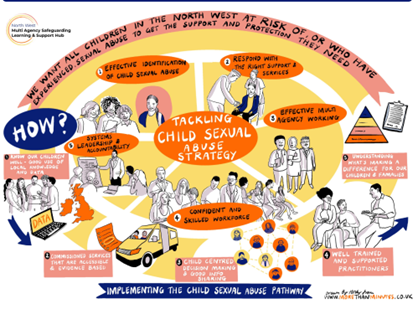
Child Sexual Abuse Strategy
Our Localised Sexual Abuse Strategy is in development
Guidance and Practice Resources
Child Sexual Abuse Response Pathway
The Child Sexual Abuse Response Pathway is an interactive online resource. It is designed to support professionals in identifying and responding to child sexual abuse, and empower them to learn more about the role they, and their colleagues, can play to best protect and support children.
The Response Pathway sets out how to respond to concerns of child sexual abuse at key points: from first concerns and early help safeguarding through to child protection and criminal justice responses. Throughout, it focuses on meeting the needs of children and their families.
Signs and Indicators – A template for identifying and recording concerns of Child sexual abuse
Communicating with Children : A guide for those working with children who have or may have been sexually abused - To give professionals the knowledge and confidence to speak to children about sexual abuse.
Supporting parents and carers: A guide for those working with Families affected by Child Sexual Abuse To help professionals understand more about how child sexual abuse affects parents and their children, when concerns have been raised or identified, so that they can support them effectively.
Safety Planning in Education: A guide for professionals supporting children following incidents of Harmful Sexual Behaviour
Communicating with children for education professionals
Communicating with parents and carers A guide for education professionals when there are concerns about sexual abuse or behaviour
Managing Risk and Trauma after online Sexual Offending: A whole family Safeguarding Guide
Sibling Sexual Behaviour: A guide to responding to inappropriate problematic and abusive behaviour.
Harmful Sexual Behaviour -“The term ‘harmful sexual behaviour’ describes a continuum of behaviours displayed by children and young people under 18, ranging from those considered ‘inappropriate’ at a particular age or developmental stage to ‘problematic’, ‘abusive’ and ‘violent’ behaviours”. Centre of Expertise on Child Sexual Abuse – Key Messages (Feb ’23)
Interventions, like assessments should be proportionate to the nature and extent of the behaviour, and to the child or young person’s age and developmental stage; joined-up, multi-agency working and discussion is needed, to avoid agencies under- or overreacting to harmful sexual behaviour.
There are various assessments that are used when we have concerns about HSB. Some of these include AIM and the Sexual Behaviours Traffic Light Tool by Brook. Both of these tools require practitioners to be trained in the use of the assessments/screenings.
Cheshire West & Chester and their Pan-Cheshire Partners have adopted the ERASE TOOL which has been developed by St Helens Safeguarding Children Partnership and have kindly given their permission to its adaptation to reflect local pathways.
Further information on harmful Sexual Behaviour can be accessed here.
Relevant Pan-Cheshire Policies & Procedures
Child Sexual Abuse in the family environment
Child Sexual Exploitation
Children and young people (under 18) who display Harmful Sexual Behaviour
Online safety
Underage sexual activity
Supporting Supervision and Team meetings
A guide to help professionals kickstart discussions about improving responses to child sexual abuse
The Centre of Expertise advise using "Supporting supervision and team meetings" to improve responses to child sexual abuse. This guide helps professionals start discussions about child sexual abuse within their teams in a supportive space, reflect on the experiences of children and families they are working with, explore their team’s and their own welfare, and consider how the evidence might inform and develop their practice.
It helps managers and supervisors support professionals at all stages of their careers across the children’s services workforce, including those in child protection, working with children with disabilities, children in care, adult social care, youth offending or early help.
Training Opportunities
FREE COURSE - Identifying and responding to intra-familial child sexual abuse
Victims and survivors of intra-familial child sexual abuse can and do recover from their abuse, especially when supported by professionals who are trained to best support them and their families.
The CSA Centre’s first eLearning course, Identifying and responding to intra-familial child sexual abuse, takes just 90 minutes to complete, is entirely free and consists of three engaging modules, with interactive tasks, video explainers and a final assessment.
It’s designed for professionals at all stages of their career; for those new to safeguarding, or as a helpful refresher.
Gain confidence in your understanding of intra-familial child sexual abuse today and get your certificate today
Local Support Services
Rape and Sexual Abuse Support Centre - RASASC (Cheshire and Merseyside) is a registered charity committed to supporting people who have been affected by rape or sexual abuse.
It does not matter how long ago it occurred or what happened – they are there to help. They have been providing support to people affected by sexual violence since 1995.
RASAC have offices in Chester, Crewe, Ellesmere Port, Knowsley, Halton, Northwich, Macclesfield, St. Helens and Warrington as well as offering outreach support in locations across Cheshire and Merseyside.
Information and helpline: 0330 363 0063
The information line is open Monday to Friday 9.00 until 4.00 and is available on any of these numbers.
Cheshire East: 01260 697900
Cheshire West & Chester: 01244 907710
Halton: 01928 477980
Knowsley: 0151 218 7960
St. Helens: 01744 877987
Warrington: 01925 221546
Leave a message should you need to contact RASAC out of these hours and a member of their team will return your call as soon as possible.
SARC - Sexual Abuse Referral Centre -Sexual Assault Referral Centre (SARC) - Saint Mary's Hospital
The Survivors Trust - Rape & Sexual Abuse Services UK
Rape Crisis - SARCs | Rape Crisis England & Wales
Further Resources and reading
Government and National
Centre of expertise
Cheshire Police Consent resources
NSPCC
Lucy Faithful Foundation